Store Visits Tracking from Facebook Hits the Shelves

screen-shot-2016-09-15-at-3-16-17-pm

Unless you’re a big brand or agency, you probably haven’t gotten direct access yet to Store Visits tracking on Google or Facebook. It looks like Facebook is now rolling out their version of the metric with a new ad objective.

“With over 90% of all transactions still taking place offline, driving customers into a store, restaurant, auto dealership or other place of business remains a primary marketing objective for any advertiser with brick-and-mortar locations.”

Essentially the feature allows you to determine how many users visited your business location after clicking on a Facebook ad. While this is exciting news to anyone that advertises on Facebook, there are minimum thresholds that need to be met before FB will grant eligibility.

screen-shot-2016-09-15-at-3-18-28-pm

This has been something marketers have been craving for as long as digital has been driving sales. Everyone has micro-moments, everyone does research online and many people make purchases online, but what about the people that just go into a store to make the final purchase? If not attributed directly or proper expectations are not set, marketers can oftentimes be left out to dry by the gap in data. So while it remains to be seen how well this new ad type will work, it is quite exciting for any brick and mortar locations.

“This objective has been specifically created for brick and mortar businesses who want to reach customers in the right location, with localized ad content and the ultimate goal of driving customers in-store. Additionally, over the next couple weeks, we are rolling out enhancements to the Store Visits objective which will allow you to not only report on store visits, but optimize your ads towards those most likely to visit.”

Facebook is describing this as the “Evolution of Local Awareness on Facebook and Instagram.” They might be right.
Ambiguity is the Enemy of Attribution: Facebook to Roll Out Store Visits Tracking

FBStoreVisitsTracking
We’re getting closer to closing the loop on digital marketing. Ambiguity is the enemy of attribution. Facebook just announced it will soon begin rolling out its own Store Visits tracking functionality for ad campaigns.

Google started the trend when it launched a very similar program nearly two years ago to track Store Visits after a user saw or clicked a business’ ad. However, this is still something that requires a very large threshold of clicks and quite frankly geographical footprint. It’s not accurate enough yet for small business owners to take advantage of. It looks like Facebook may be identifying an opportunity to strike while the iron is hot.

Ask any digital marketer working with a brick-and-mortar business what the biggest challenge is and they will tell you attribution. I hear it all the time from clients that understand they need to run digital and social campaigns and may even acknowledge they are performing well, but what does that really mean to them? Without any real data on how much foot traffic these campaigns are driving there will always be that question mark. Unless of course you have a client where you can tie in with their in-house Point-Of-Sales (POS) system to track purchases, but that’s not always available.

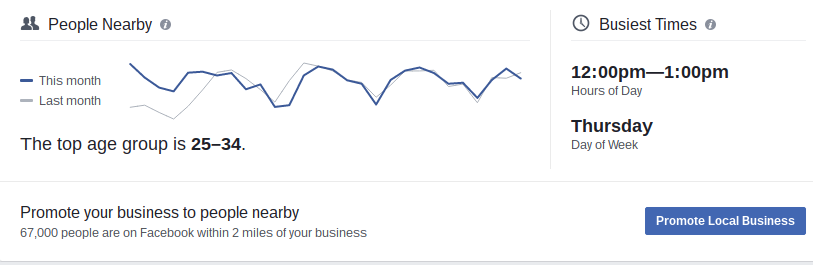
So over the next few months Facebook will begin rolling out its own Store Visits tracking, which makes a ton of sense considering that its Local Awareness Ads are designed to drive this exact action. I think we saw the early glimpses of this with Local Insights, which can be found in your Facebook business page’s Insights and then under Local. An incredibly effective tool that can tell you loads of information about which kind of people your ads are reaching nearby your location, what their demographics are, what times are most popular etc. to help optimize your local ads. You can actually narrow the radius down to as tight as 165 feet around the location!

Screenshot 2016-06-16 at 4.04.04 PM
Screenshot 2016-06-16 at 4.03.56 PM
The No. 1 biggest regret for Google in my opinion was the failure to launch of Google+. For any Store Visits tracking to work Google requires people to have their Location Tracking on their phone enabled, as does Facebook but so many more people allow it because as a social platform it provides that additional value (check-ins, local reviews etc.). If Google could have gotten G+ to take off like it hoped, combined with its treasure trove of data on user intent, they would have ran the world. So utilizing that location tracking information along with wi-fi signals, Facebook will be able to coordinate when a user sees or clicks and ad and goes within that business’ geo-fenced area.

If you tell a client that his Local Awareness ad got 850 Clicks and drove 100 Calls he may say that’s great, but if you’re able to tell a client this campaign specifically drove 250 people directly into their store? Now that is valuable data.

Facebook will also be rolling out the ability to connect Ads Reporting with a location’s POS system to track sales via the Offline Conversions API.

“Advertisers now have a way to connect transactions that take place in store or over the phone to their ads. The Offline Conversions API allows businesses to match transaction data from their customer database or point-of-sale system to Ads Reporting, helping them better understand the effectiveness of their ads in real-time. Businesses can work with partners such as IBM, Index, Invoca, Lightspeed, LiveRamp, Marketo and Square or with Facebook directly.”

Facebook says these functionalities will be rolling out to all advertisers globally in the coming months so start getting your clients prepared now.